7.1.2How can I model rates of change?
Related Rates Applications: The Pythagorean Theorem

Ships A and B are attached by a cable of length
. As Ship B moves toward point Q, Ship A moves toward point P. Consequently, if represents time, and are related rates. Describe the speed of Ship A as it approaches point P. Justify your answer.
Are
and each positive, negative, or zero? If
is constant, how does change?
.png)
and ? Are they each positive, negative, or zero? If the rate that the rope is released, , is constant, will the rate that the balloon rises, , be constant as well? If not, how will change? The related rates situations in parts (a) and (b), as well as the boat situation in problem 7-5 each involved one rate that was constant while another rate increased or decreased. Consequently, the related rates were not proportional.
Examine these diagrams in the three situations closely. What geometric shape do they all have in common? What equations come to mind when examining this shape?
.png)
While painting his house one day, Mr. Cabana had a terrible accident! The bottom of the
Draw a diagram of this situation. Then write an equation that relates the sides of that shape in your diagram.
Mr. Cabana wants to know how fast he is falling when the ladder is
feet above the ground. You need to help him solve this problem, but the equation you wrote in part (a) does not involve rates. What Calculus tools can you use to convert the equation in part (a) to a rate equation? Explain why the rate the ladder is sliding down the wall must be related to the rate that the foot of the ladder moving along the ground.
PAINFUL PAINTING, Part Two
.png)
Label each side of your diagram from problem 7-14 with a side length and an expression for its rate of change. Substitute any numeric values that are known.
Use the strategy you suggested in part (b) of problem 7-14 to convert the equation that relates the sides of the geometric shape into a new equation that relates the rate that each side is changing.
Use your equation from part (b) to answer Mr. Cabana’s question: How fast will he be falling at the moment when the ladder is exactly
feet above the ground? Explain why the rate you found in part (c) is negative.
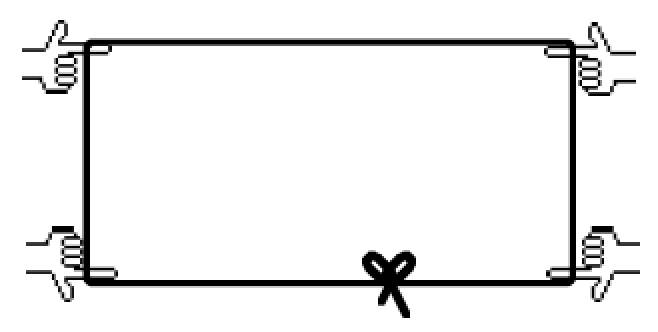
Help Sophia calculate the rates below when
What is the rate of change of the perimeter of the rectangle?
What is
? Calculate the rate of change of the area of the rectangle.
Calculate the rate of change of the length of a diagonal of the rectangle.

Hustling Harry hastily got the following answer to the indefinite integral below. Verify that he is incorrect, and explain what he did wrong. Homework Help ✎
It just so happens that Hustling Harry’s grade in math class at any week
A point travels along the
What does
represent? Where is the particle located when
? What is the velocity of the particle when its acceleration is zero?
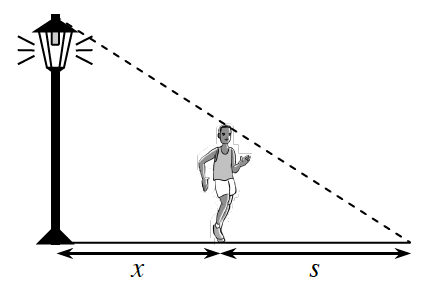
Solve for
THE WEDDING CAKE, Part One
Kiki is ordering a wedding cake for her upcoming reception. She is considering a four-layer circular cake, where the diameters are
Write a Riemann sum to approximate the volume of Kiki’s cake.
The bakery has informed Kiki that she should have approximately
in3 of cake per guest at the reception. She expects guests at her wedding. Will she have enough cake?
.png)
Explain how the first derivative can be used to determine a local minimum or a local maximum. Be sure to distinguish between the two. (Note: What if the first derivative is undefined?) Homework Help ✎